 +91
8929781602
+91
8929781602  +91 9820027691
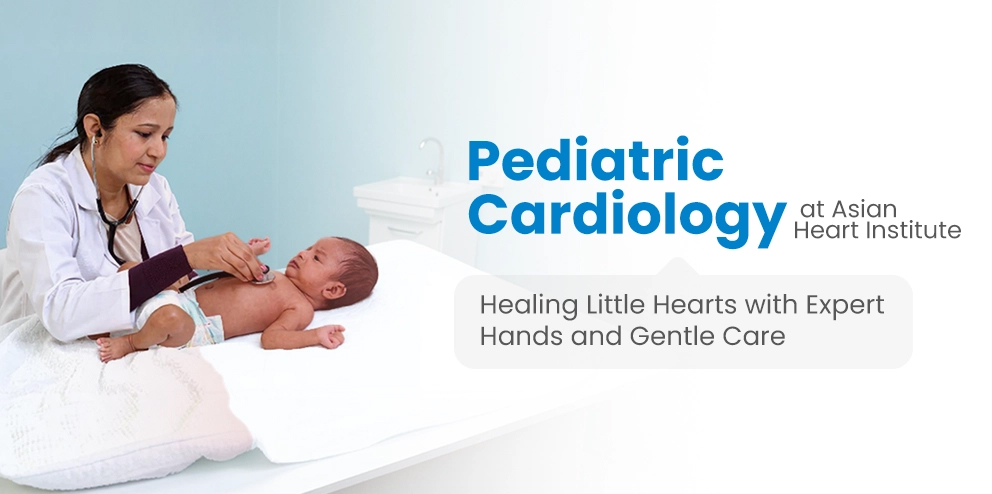
Advanced Heart Care for Kids, with Compassion and Accuracy
At Asian Heart Institute, we know that the heart of a child requires more than treatment alone—it requires care, comfort, and ongoing support. Our Pediatric Cardiology specialists offer thorough diagnosis and treatment of various heart conditions in infants, children, and teenagers using cutting-edge technology, kid-friendly procedures, and extensive experience.
What is Pediatric Cardiology?
Pediatric Cardiology is the specialty of medicine that deals with the diagnosis and management of heart problems in children, including those congenital (present at birth), those acquired later in life, and electrical or structural disorders. All of these are usually treatable or even curable if diagnosed early.
At the Asian Heart Institute, we provide a total child-centered solution—integrating non-invasive diagnostics, world-class treatment, and long-term follow-up all in one location.
Diseases and Conditions We Treat
Our board-certified pediatric cardiologists diagnose and treat the entire range of heart problems, from birth defects to rhythm disturbances to acquired heart conditions.
Congenital Heart Defects (Heart Defects that Exist at Birth)
- Anomalous Pulmonary Veins – The pulmonary veins from the lungs attach abnormally to the heart, impairing oxygen supply.
- Aortic Valve Stenosis – The aortic valve that distributes blood to the body is narrowed, requiring the heart to exert more effort.
- Atrial Septal Defect (ASD) – A defect in the upper heart wall leads to mixing of blood between the chambers.
- Atrioventricular Canal Defect – An enlarged hole in the heart impacts valves and chambers.
- Coarctation of the Aorta – The aorta, the artery carrying blood from the heart, is narrowed, thus restricting blood to the body.
- Coronary Artery Anomalies – Misplacement or development of the heart's own arteries.
- Ebstein's Anomaly – A valve between the heart chambers fails to develop normally, which causes leakage.
- Hypoplastic Left Heart Syndrome (HLHS) – The left heart is underdeveloped and unable to pump effectively.
- Mitral Valve Abnormalities – Defects in the valve between heart chambers that impair blood flow.
- Patent Ductus Arteriosus (PDA) – A fetal blood vessel remains open after birth, resulting in excessive blood flow to the lungs.
- Pulmonary Artery Stenosis – The arteries to the lungs are narrowed, causing the heart to work harder.
- Pulmonary Valve Atresia – The pulmonary valve is either missing or blocked, stopping blood from getting to the lungs.
- Pulmonary Valve Stenosis – A narrowed pulmonary valve hinders the flow of blood from the heart to the lungs.
- Tetralogy of Fallot (TOF) – An association of four defects lowering the oxygen in the blood.
- Transposition of the Great Arteries (TGA) – Heart arteries are reversed, which impacts blood circulation.
- Tricuspid Atresia – A defective heart valve prevents blood from passing to the lungs.
- Truncus Arteriosus – There is only one blood vessel exiting the heart, rather than two, mingling oxygenated and non-oxygenated blood.
- Vascular Ring – Pathological vessels form a ring around and compress the windpipe or esophagus.
- Ventricular Septal Defect (VSD) – Abnormal blood flow is caused by a hole in the lower heart chambers.
Arrhythmias (Heart Rhythm Problems)
- Atrial Fibrillation – The upper chambers are beating too fast and not together.
- Atrial Flutter – Rapid, regular beating of the upper heart chambers.
- Long QT Syndrome – A condition that causes hazardous, rapid heartbeats.
- Wolff-Parkinson-White Syndrome (WPW) – There is an extra electrical pathway that causes rapid heartbeats.
Cardiomyopathies and Heart Function Disorders
- Dilated Cardiomyopathy – The heart enlarges and is unable to pump properly.
- Hypertrophic Cardiomyopathy – The walls of the heart thicken, hindering normal blood flow.
- Myocarditis – Inflammation of the heart muscle, usually due to a virus.
- Heart Failure in Children – The heart is unable to supply the body with needed blood and oxygen.
Acquired and Other Pediatric Heart Disorders
- Eisenmenger Syndrome – In young people with untreated heart defects, the long-term consequence of reversed blood flow.
- Kawasaki Disease – A disease that inflames the blood vessels and can cause damage to heart arteries.
- Pulmonary Hypertension – Elevated pressure within lung blood vessels forces the heart to work harder.
Pediatric Cardiology Services We Provide
We offer a wide range of non-invasive and interventional cardiac care services:
- Fetal Echocardiography (Identifies heart defects during pregnancy)
- Pediatric Echocardiography (2D/Color Doppler for visual heart examination)
- Electrocardiogram (ECG) and Holter Monitoring (Analysis of heart rhythm)
- Cardiac MRI & CT Angiography (Advanced structure and blood flow imaging)
- Cardiac Catheterization (In-depth diagnosis and pressure testing)
- Device Closure for ASD, PDA, or VSD (Non-surgical closure via cath lab)
- Electrophysiological Studies (EPS) and Radiofrequency Ablation (To treat abnormal heart rhythms)
- 24/7 Pediatric Cardiac Emergency Services
Why Is Early Pediatric Cardiology Important?
Identifies congenital heart issues early on:
- Avoids complications such as heart failure or lung injury
- Tracks development and oxygenation
- Enables prompt surgical or non-surgical treatment
- Reduces risk of hospitalisation later in life
How to Prepare for a Pediatric Cardiac Consultation?
Bring previous medical records and tests
- Write down symptoms: blue lips, tiredness, fainting, pain in the chest
- Report any family history of cardiac issues
- Your child can be given a painless ECG or echo
- A friendly, welcoming atmosphere for both child and parent to expect
Complete Heart Care for Your Child
We provide end-to-end pediatric cardiac care, including:
- Early diagnosis and risk screening
- Non-invasive and interventional treatment
- Pediatric cardiac ICU treatment if required
- Ongoing monitoring and counseling
- Education of parents and counseling
Asian Heart Institute
Why Choose Us
- Expert Pediatric Cardiologists & Heart Surgeons
- State-of-the-Art Facilities for precise and secure diagnosis
- Kids-Friendly Setting to comfort and reassure
- End-to-End Pediatric Cardiac Care\from testing to surgery
- Emotional Support Staff trained to handle children
- Honest Communication with families at each step

Quick Query
Questions or help with booking? We're here to assist you with:

Booking your child's appointment
 Book an Appointment
Cost and insurance questions
 Enquire Now
Pre-test information
Enquire Now

Second opinions
Book an Appointment

Emergency assistance
Enquire Now
Fill in your details—we'll call you back immediately.
Enquire Now
We’ll respond quickly because your health can’t wait.
Frequently Asked Questions
Q1: Can a child's heart defect be seen during pregnancy?
A: Yes. A fetal echo at 18–22 weeks can see many defects before the baby is born.
Q2: Is a pediatric ECG or echo painful?
A: No. These are easy, harmless, and painless tests taken within minutes.
Q3: What if surgery is required?
A: Our Pediatric Cardiac Surgery staff can manage even the most complicated surgeries with outstanding success rates.
Q4: How frequently should follow-ups be conducted?
A: Depending upon the ailment, but generally, most children with heart diseases require follow-ups every few months or once a year.
Q5: Is pediatric cardiac treatment insured?
A: Yes. Cardiac assessments and treatments are usually insured. We support paperwork and approvals.